Real Wedding Film
Osmaston Park Wedding Videographer
Payal & Matt — 13 June 2026
A last-minute booking that became one of the most varied weddings I’ve filmed — two ceremonies, huge entrances, open Derbyshire countryside, speeches, games and a brilliant bhangra and ceilidh dance finale.
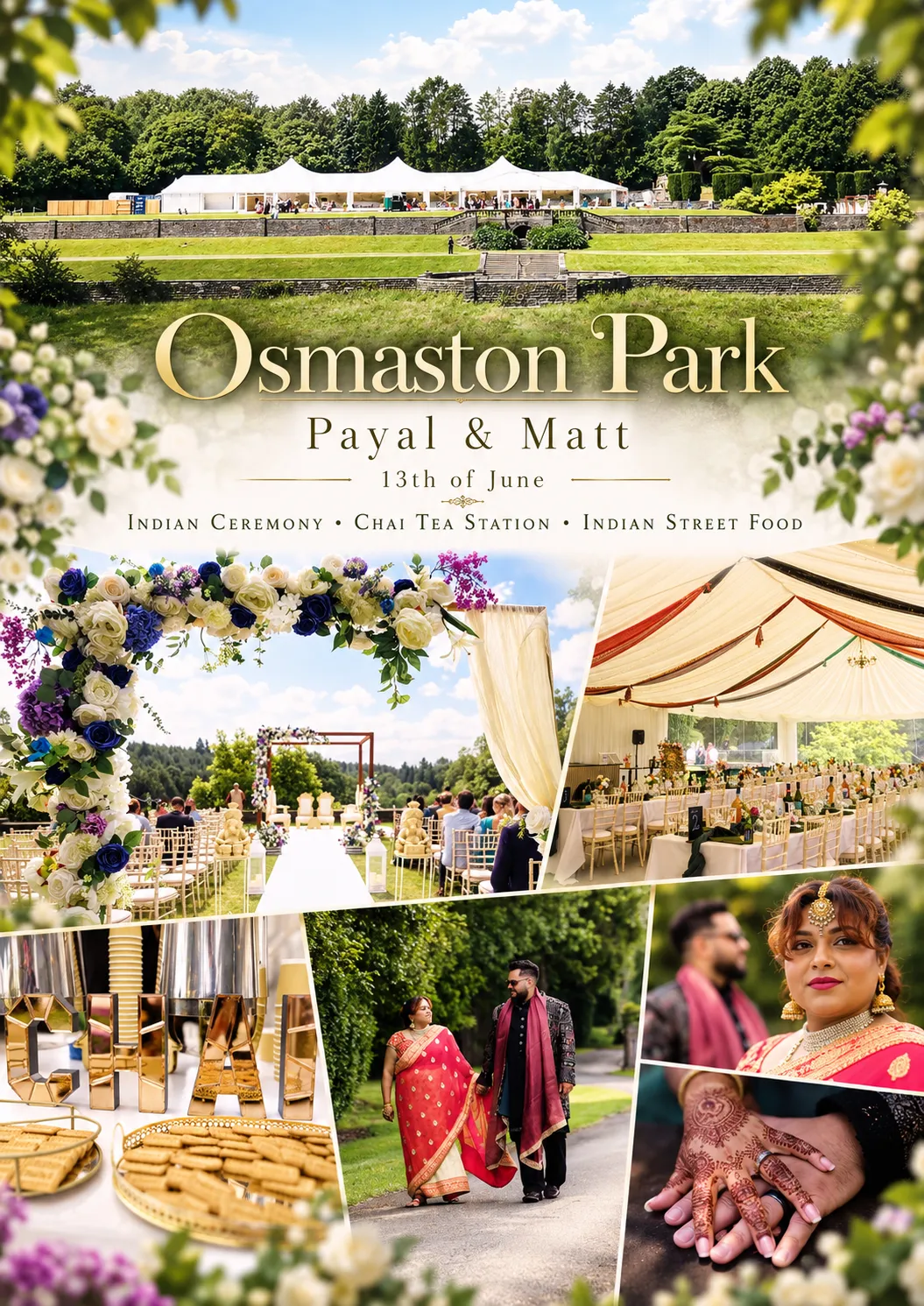
Payal & Matt — Osmaston Park, 13 June 2026
Payal & Matt’s Wedding Film
Two ceremonies, two very different entrances and a full day of family, colour and celebration at Osmaston Park in Derbyshire.
A booking that came together in a week
I only found out I was filming Payal and Matt’s wedding about a week before it happened.
This wasn’t actually a booking that came directly from the couple.
Jacque Prates, a photographer I’d worked with over the last few years, got in touch after the videographer originally booked for the wedding had cancelled.
Because we’d worked together before, Jacque already knew how I worked and what I could deliver. She explained what was needed, I confirmed I was available and a few conversations later Osmaston Park was in my diary for the following weekend.
It also meant I arrived on the day having never met Payal or Matt.
Normally I’ll know quite a bit about a couple before their wedding. This time I had to arrive, introduce myself and very quickly understand how a fairly complicated day was going to work.
A venue that made me question what used to be there
I'd never filmed at Osmaston Park before, so I deliberately arrived early enough to have a look around before everything started.
At first, the main wedding space looked almost surprisingly simple — a large marquee surrounded by a huge amount of open countryside.
Then I noticed the terraces.
I sent the drone up for a look from above and suddenly the layout made more sense. The remaining stonework and the shape of the ground made it look as though a substantial building must once have stood there.
That first impression turned out to be right. Osmaston Park says the wedding marquee now sits on the original foundations of the old manor house.
From the air you also get a much better sense of the setting. The venue feels very open and very private, with countryside, trees and the lake stretching away from the wedding space.
It doesn't feel like a wedding squeezed into a building. It feels like you've been given a large piece of Derbyshire for the day.
Getting the plan together as I went
Because I hadn't been involved in the planning, my first job was basically information gathering.
At the venue I met the photographer from Studio One, who was covering the wedding on the day and was a friend of Jacque.
We had a quick conversation about the timeline and then I went to find Matt.
The groom and groomsmen were getting ready on site, although there wasn't really a dedicated preparation room suited to filming. The available space was fairly small with difficult light, so rather than force preparation footage where it wasn't wanted, I waited until the guys were dressed and took them outside.
That gave me something much stronger anyway — clean, stylish footage of Matt and the groomsmen in the surroundings of the venue.
Payal was getting ready elsewhere and wouldn't arrive until shortly before the ceremony, so I already knew the beginning of the film was going to work differently from a wedding where I film both sides getting ready.
Then the wedding properly started
Once everything was ready, I saw Matt and the boys preparing to make their entrance.
I'd already been told there would be smoke bombs and dhol drummers, so I knew this wasn't going to be a quiet walk towards the ceremony.
It was brilliant. Colour everywhere, the drums going, the groomsmen around Matt and the whole group moving towards the ceremony space together.
I filmed the movement on the stabilised camera while the ceremony cameras were already covering the wider scene.
It was loud, colourful and properly ceremonial — exactly the sort of entrance that immediately gives a wedding film energy.
A long ceremony in constantly changing light
The traditional Indian ceremony was the biggest technical part of the day.
It was long, mainly stationary and taking place outside, which meant the challenge wasn't people constantly moving around. It was everything else.
One minute we had strong sunshine, then cloud, then wind, then the light would change again.
With several cameras recording at once, I needed to keep checking exposure and framing while making sure there was always at least one reliable master angle covering what was happening.
Audio mattered just as much. Everything important was being recorded separately and the microphones had proper wind protection because of the changing conditions outside.
After roughly twenty to thirty minutes, Payal arrived. And her entrance matched Matt's.
Dhol drums, smoke, bridesmaids, colour and a completely different energy entering the ceremony space. It gave us some of the strongest footage from the entire wedding.
The ceremony eventually ran closer to two hours, but all the important coverage, sound and additional shots came together exactly as they needed to.
Chai, food and room to breathe
After spending that long outside, everybody was ready for a break.
Guests moved back towards the marquee where there was chai, cold drinks, music and time to properly talk to each other.
Later an Indian street-food truck arrived, and the whole afternoon became much less formal.
That's something Osmaston Park suited really well. There was enough room for people to spread out without the wedding ever feeling empty.
Some guests stayed around the marquee, others went outside, children and families had space to move around and nobody felt as though they were being pushed from one room to another.
Before everyone completely settled into the afternoon, the photographer and I worked through the family pictures and took Payal and Matt away briefly for their couple footage.
Finally getting some time with both of them
Because Payal had arrived shortly before the first ceremony, I hadn't been able to film the same kind of individual footage with her that I'd already captured with Matt.
So the couple session gave me a chance to balance that out.
We started with some shots of Payal on her own and then moved into the couple session.
They were very natural together. They didn't need much direction, but as always I'll guide people enough to get them into good light, give them something to do and then let the interaction happen.
Studio One and I worked around each other during the session and we came away with a really strong mixture of photographs and moving footage.
The setting helped too. Osmaston gives you open views, woodland, long backgrounds and the lake without needing to drive the couple away from the wedding for an hour.
Ceremony number two
Later in the afternoon everybody gathered again for the civil ceremony.
It couldn't have been much more different from the first one.
The Indian ceremony had been long, colourful and full of tradition. The civil ceremony was deliberately minimal.
There weren't rows of chairs or another elaborate setup. It was short, simple and probably lasted around fifteen minutes from beginning to end.
But because Payal and Matt wanted both ceremonies preserved properly, I treated it with exactly the same care.
A wedding doesn't need to last ninety minutes for the recording to matter.
Four speeches inside a very full marquee
After the civil ceremony everyone went back into the marquee and waited for Payal and Matt.
The funny thing was that nobody seemed completely sure whether they were actually doing a formal entrance. I asked them. They looked at each other and basically decided, yes, they probably should.
One of the groomsmen was quickly given announcing duties and a minute later they came into the marquee with everyone cheering and applauding.
Sometimes a tiny question at the right moment creates a much better transition into the next part of the wedding.
The speeches followed almost immediately. There were four in total — emotional in places, funny in others and very centred around family.
From a filming perspective, the interesting part was the room layout. One half of the marquee was heavily populated with guests while another section opened onto the dance floor.
That limits some camera positions, so rather than chasing perfect symmetry I concentrated on keeping strong views of the speakers while still having enough reaction shots from Payal, Matt and the guests.
It's one of those situations where the room tells you where the cameras can realistically go.
A dance floor I'd never filmed before
Once the speeches finished, the wedding opened up again. The ice-cream van was busy, evening guests began arriving and people spread out across the grounds.
There were lawn games, golf, rugby and cricket, with Matt getting involved as well. This was probably where I understood Osmaston Park best.
There isn't one small prescribed wedding area where everybody has to stay. People can actually use the space. Different groups were doing different things, but they were still part of the same wedding.
The final part of the evening was genuinely something I'd never filmed before.
Instead of a traditional first dance, two dance leaders brought everyone together for a fusion of bhangra and ceilidh dancing.
The music combined the two styles rather than simply playing one and then the other. You could hear the dhol rhythms from the bhangra side alongside the traditional ceilidh sound, and somehow it all worked as one piece of music.
The instructors demonstrated the movements and then brought everybody into it. Payal and Matt were dancing, friends and family joined them and very quickly almost the entire wedding was moving.
Apart from a few older guests taking a well-earned seat, hardly anybody was watching from the sidelines.
It was less like a performance for the guests and more like turning the guests themselves into the performance.
That made it a brilliant way to finish the film.
And then I came back the next day
Technically, my Osmaston Park story didn’t finish when I drove home.
During the long Indian ceremony I’d placed one of my audio recorders near part of the ceremony setup and somehow managed to leave without collecting it.
Once I realised, I contacted the company responsible for the setup. They’d found it and kindly left it behind the bar at Osmaston Park.
So the following day I drove all the way back to collect it. The best part was discovering that it was still recording. More than twenty-four hours later.
I accidentally gave that microphone probably the most extreme real-world battery test I’ve ever done. It survived.
And it gave me one more reason to remember the wedding.
How I approached this wedding
This booking came together approximately one week before the wedding, so I had to understand the timeline quickly once I arrived.
The full Indian and civil ceremonies were the main priority, so multi-camera coverage and reliable professional audio came before everything else.
Multiple cameras gave me redundancy while still allowing me to move and capture more cinematic angles.
I adapted continuously to changing outdoor sunlight, cloud and wind rather than interfering with the ceremony.
The highlight film was built around the energy of the entrances, cultural traditions, family interactions and evening dancing.
Couple footage was guided lightly and kept relatively short so Payal and Matt could get back to their guests.
What works well at Osmaston Park
OPEN SPACE
Osmaston feels genuinely open. Guests can spread between the marquee, grounds and outdoor areas without the wedding feeling disconnected.
LAKE & COUNTRYSIDE
The lake, surrounding trees and long Derbyshire views give plenty of depth for establishing footage and couple sessions.
FLEXIBLE WEDDING FORMAT
Payal and Matt were able to have two very different ceremonies, food, outdoor games and evening entertainment without the venue forcing every part of the day into one fixed format.
ROOM FOR LARGE-SCALE MOMENTS
The entrances with dhol drummers and smoke, long outdoor ceremony and group dancing all benefited from having space around them rather than being confined indoors.
Payal & Matt’s Wedding Gallery
Getting married at Osmaston Park?
If you like the feeling of Payal and Matt’s film, the best place to start is The Film — my main wedding videography package from £1,549. It includes full-day coverage, a highlight film, trailer, ceremony, speeches, first dance where possible, professional audio, drone where possible and a private online gallery.